
STILL SEEING THE SAME STUDENTS FOR THE SAME CANNABIS VIOLATIONS?
-1.png?width=300&height=74&name=THC%20101%20JV%20(1)-1.png "THC 101 JV (1)-1")
Staff are stretched thin. Students complete consequences, but behavior, attendance, and academic performance don’t improve. It’s time for a more effective, student-centered approach that reduces repeat incidents without adding to your team’s workload.
USED BY SCHOOLS NATIONWIDE TO MEET MANDATES AND REDUCE HIGH-RISK BEHAVIOR
SEE HOW YOUR SCHOOL CAN SIMPLIFY CANNABIS INTERVENTION
Take a closer look at how THC 101 helps reduce repeat violations and support student accountability without adding more to your plate.
STUDENTS WILL LEARN:
- Improve student outcomes and attendance
- Respond consistently to behavior incidents
- Reduce repeat violations and lost instructional time
All while managing staff burnout, limited capacity, and increasing caseloads.
Disciplinary responses alone often fall short, especially when the same students continue to cycle through the same consequences.
STUDENTS WILL LEARN: WHAT MANY SCHOOLS ARE EXPERIENCING:
- The same students returning with repeat violations
- Lost class time tied to suspensions and disciplinary processes
- Low engagement with traditional interventions
- Inconsistent responses across staff or sites
- Limited visibility into whether interventions are working
When systems are fragmented, it becomes harder to intervene early when it matters most.
MOVE FROM REACTIVE DISCIPLINE TO PROACTIVE INTERVENTION
THC 101 is an evidence-based, online intervention designed for middle and high school students following cannabis-related incidents.
- Assign in just a few steps
- Students complete courses independently
- Monitor progress and completion in real time
- Access measurable outcomes to guide decisions
No complex systems. No added burden on your team.
Start with the whitepaper to explore how schools are using evidence-based, personalized courses to address behavior early before patterns repeat:
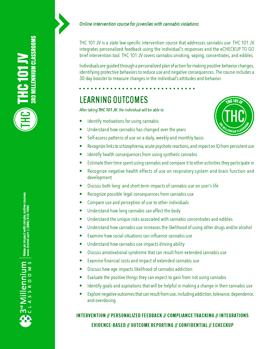
STUDENTS WILL LEARN:
- How cannabis use impacts brain development, learning, and academic performance
- The effects of THC on decision-making, motivation, and behavior
- How to recognize personal patterns, triggers, and risk factors
- The short- and long-term health risks, including high-potency THC products
- How cannabis use can affect attendance, goals, and future opportunities
- Practical strategies to reduce or avoid use in high-risk situations
- Skills to make informed, responsible decisions in real-world scenarios
- How to align choices with personal goals, expectations, and school success